by Publius
Today, in 1866, the Democratic government in New Orleans ordered a raid on a racially integrated meeting of the Republican Party. 40 people were killed and 150 were injured. Remember.

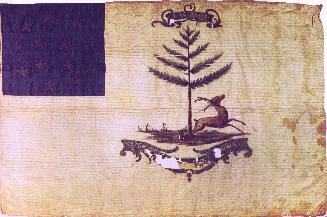 Connecticut was rather slow to bring Blacks into its militias, and so Blacks who sought to gain land or freedom through the war had to join the militias in neighboring states. For example, the Black Rhode Island Regiment fought at the important Battle of White Plains.
 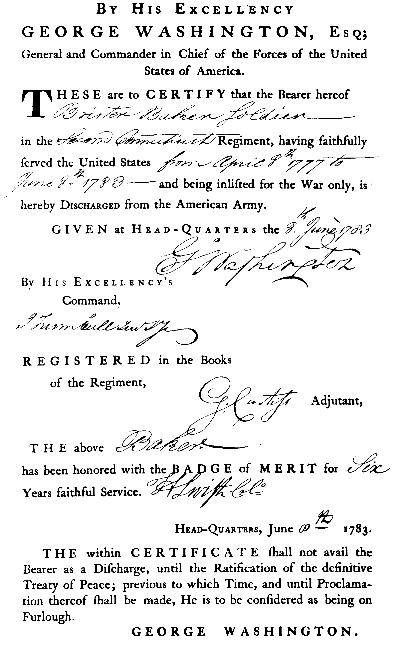 Copy of the Honorable Discharge for Brister Baker, 1783, from Colored Patriots of the American Revolution, by William C. Nell. Brister Baker was a Black soldier who fought in the Second Connecticut Regiment. The meritorious discharge notes that Baker was enlisted into the Army in April 1777 and served six years faithfully. The discharge does not make note of the fact that Baker was Black, as would census records in the next century when biological racism emerged. Copy of the Honorable Discharge for Brister Baker, 1783, from Colored Patriots of the American Revolution, by William C. Nell. Brister Baker was a Black soldier who fought in the Second Connecticut Regiment. The meritorious discharge notes that Baker was enlisted into the Army in April 1777 and served six years faithfully. The discharge does not make note of the fact that Baker was Black, as would census records in the next century when biological racism emerged. |
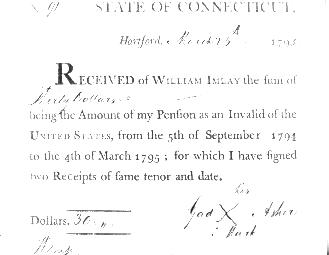 Of course, the issues over which the War of Independence were fought was a matter of complete indifference to Blacks because they were not involved in commerce. Consequently, there had to be rewards. Pensions were an obvious choice, for they did not make the recipient a property owner able to vote. If the person happened to be a slave, the obvious thing to do with his pension reward would be to assign it over to their owners to pay for their freedom. Here is a pension receipt for the Black soldier, Gad Asher, signed with his mark on 4 March, 1795. While Asher was from New Haven at the time, his son, Jeremiah Asher, later moved to Hartford where his descendents continued to live.
